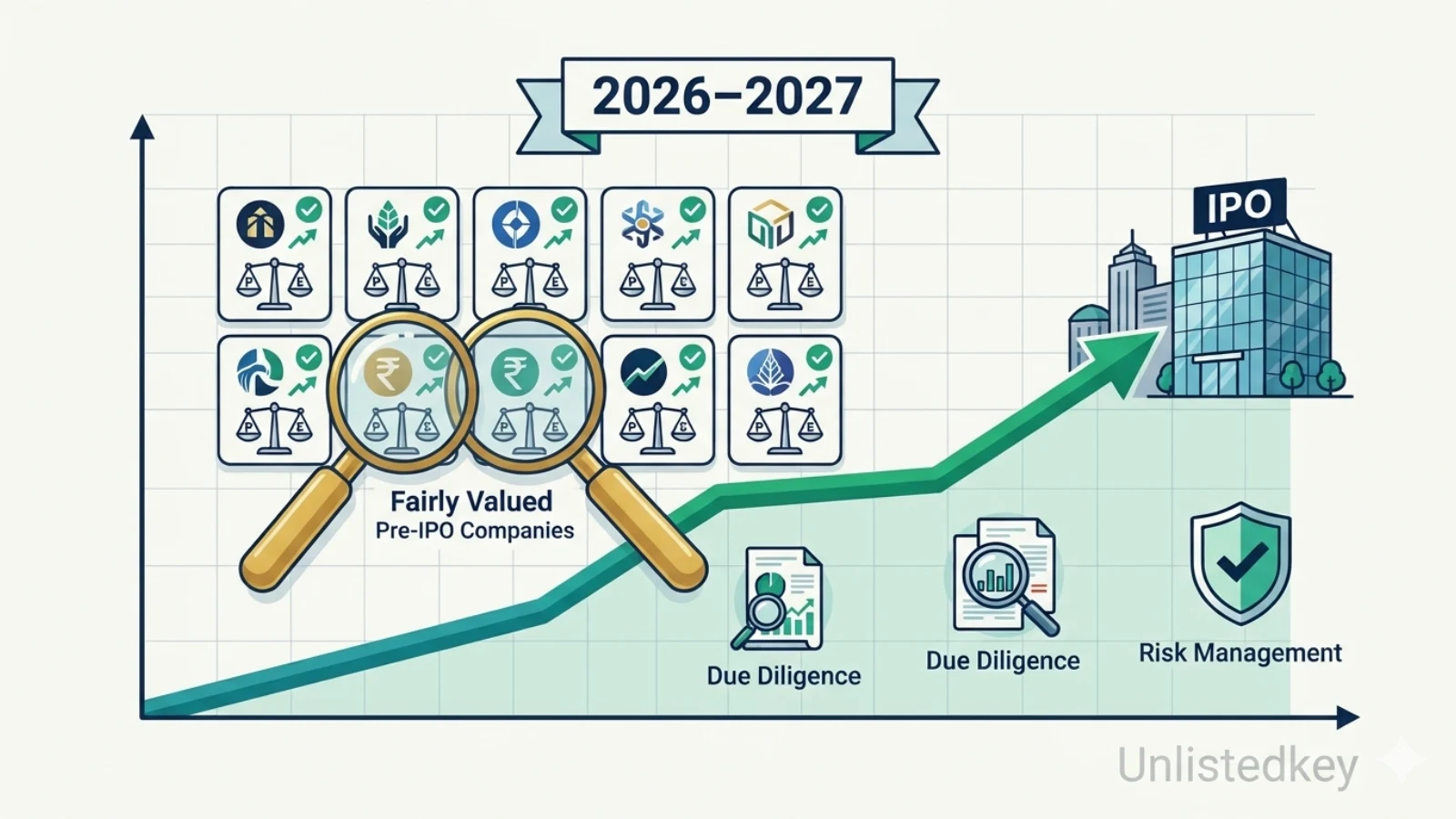
Why "Famous Brand" Does Not Always Mean "Best Unlisted Share"
Whenever someone starts searching for the best unlisted shares to buy in India, most blogs hand them the exact same list of ten famous consumer brands—without ever mentioning whether those companies actually make a profit or what Price-to-Earnings (P/E) multiple they trade at.
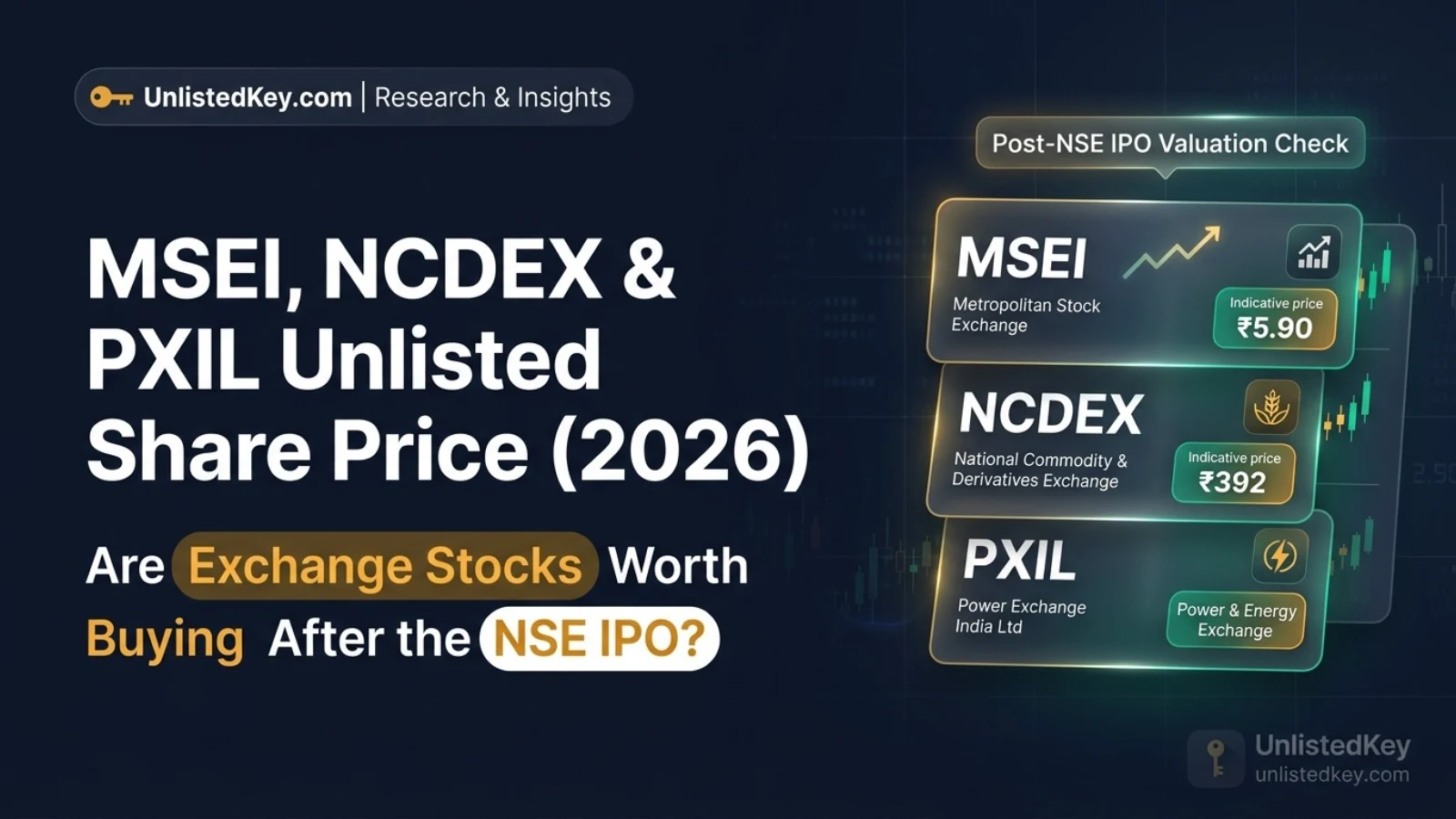
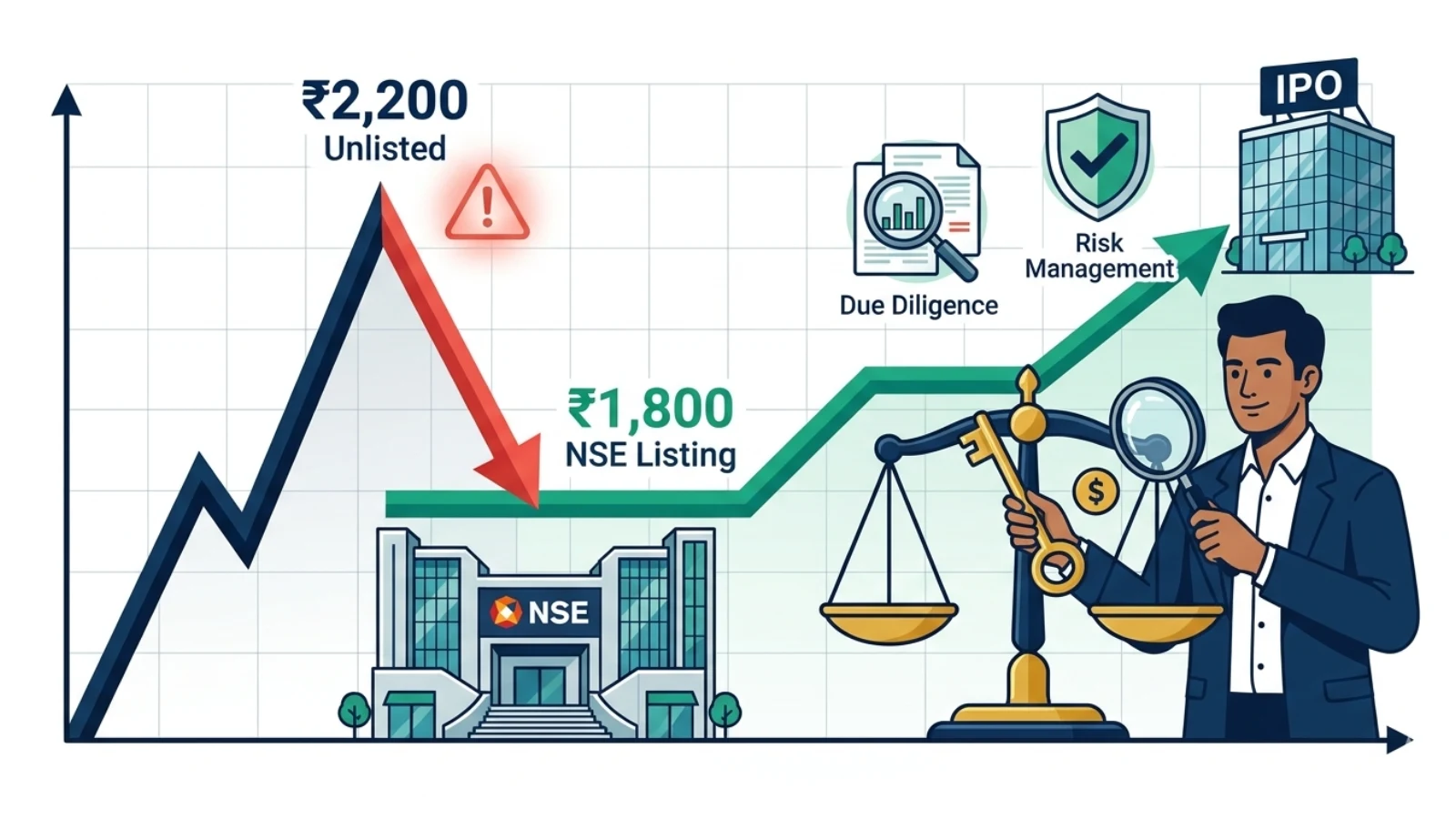
As Indian investors saw in 2025 and 2026, buying a famous name blindly in the unlisted market can hurt your portfolio. Retail buyers who paid ₹2,000 to ₹2,200+ for NSE unlisted shares saw the IPO come at ₹1,785 and list at ₹1,800 (Economic Times). Before that, investors who chased HDB Financial Services at ₹1,500+ in the private market watched the official IPO price band land roughly 40% lower at ₹700–₹740 (Zerodha).
Why did that happen? Because those buyers looked only at the brand name, not the valuation multiple.
At Unlisted Key, we track indicative dealer quotes, multi-year audited financials, and valuation ratios across 128 unlisted and pre-IPO companies in India. Instead of chasing loss-making startups or stocks trading at 100x earnings, smart HNI and retail investors filter for profitable businesses trading at a reasonable P/E ratio (under 21x) and healthy Price-to-Book (P/B) multiples.
Below is our data-backed breakdown of 10 fairly valued unlisted companies in India for 2026–2027 based on reported financials and indicative quotes on the Unlisted Key Screener.
Quick Comparison: 10 Fairly Valued Unlisted Shares (P/E Under 21x)
Every figure in the table below is derived from the reported financial statements and dated dealer quotes published on Unlisted Key and the Unlisted Key Screener:
# | Company Name | Sector | Indicative Price (₹) | Market Cap (₹ Cr) | P/E Ratio | Key Fundamental Highlight |
1 | Renewable Energy | ₹46 – ₹60 | ₹494 Cr | 4.3x | ₹1,001 Cr Net Sales & ₹115 Cr PAT; 0.7x Price-to-Book (Unlisted Key Screener) | |
2 | Semiconductors | ₹48 – ₹54 | ₹1,913 Cr | 5.1x | ₹1,903 Cr Net Sales & ₹376 Cr PAT; 1.6x Price-to-Book (Polymatech on Unlisted Key) | |
3 | Energy / EPC | ₹70 | ₹284 Cr | 8.4x | Single-digit P/E clean energy & EPC play (Unlisted Key) | |
4 | Industrials | ₹555 | ₹196 Cr | 10.1x | Profitable industrial valve exporter at ~10x earnings (Unlisted Key) | |
5 | Materials | ₹900 | ₹72 Cr | 11.6x | Niche specialty minerals maker with steady margins (Unlisted Key) | |
6 | NBFC & Lending | ₹242 | ₹13,196 Cr | 15.0x | ₹7,867 Cr Net Sales, ₹880 Cr PAT & 1.3x P/B (Unlisted Key Screener) | |
7 | Technology / IT | ₹10,650 | ₹62,835 Cr | 15.3x | ₹32,618 Cr Net Sales & ₹4,102 Cr PAT; blue-chip IT (Capgemini on Unlisted Key) | |
8 | Infrastructure | ₹22 | ₹391 Cr | 15.4x | Low 0.4x Debt-to-Equity infrastructure PPP model (Inkel on Unlisted Key) | |
9 | Materials / Steel | ₹322 | ₹2,205 Cr | 19.9x | High-demand steel manufacturer with 33+ price snapshots (Unlisted Key) | |
10 | Financial Services | ₹344 – ₹375 | ₹4,273 Cr | 20.4x | ₹210 Cr PAT on ₹488 Cr sales; trading at 0.8x P/B (Unlisted Key Screener) |
(Note: Unlisted share prices are indicative dealer quotes, not live exchange feeds, and can vary between snapshots on Unlisted Key.)
Detailed Breakdown of the 10 Companies
1. Onix Renewable (P/E: 4.3x | P/B: 0.7x)
Most renewable energy stocks in India trade at massive valuation multiples—for instance, Inox Clean Energy currently quotes at an implied market cap of ₹71,294 crore on ₹82 crore of net sales (Unlisted Key Screener). By contrast, Onix Renewable stands out on the Unlisted Key Screener with ₹1,001 crore in reported net sales and ₹115 crore in Profit After Tax (PAT). At an indicative price range of ₹46 to ₹60 and a market cap of roughly ₹494 crore, it trades at just 4.3x earnings and 0.7x book value (Unlisted Key, Unlisted Key Screener).
2. Polymatech Electronics (P/E: 5.1x | P/B: 1.6x)
Everyone talks about India's semiconductor mission, yet very few investors check the underlying earnings of unlisted chip and opto-electronics makers. Polymatech Electronics has scaled to ₹1,903 crore in net sales and ₹376 crore in net profit (Unlisted Key Screener). At an indicative price of ₹48–₹54 per share (₹1,913 crore market cap), the stock sits at a 5.1x P/E multiple and 1.6x Price-to-Book—offering rare valuation comfort in a high-growth tech manufacturing sector (Unlisted Key, Unlisted Key Screener).
3. Apollo Green Energy (P/E: 8.4x)
Part of the Apollo International group, Apollo Green Energy focuses on renewable power projects and engineering, procurement, and construction (EPC) execution. After a 1-year price cool-off of 35.2% that brought its indicative price down to ₹70 per share (₹284 crore market cap), the company now trades at a modest 8.4x P/E ratio on Unlisted Key. For value-conscious investors, buying after a price correction is often far safer than buying at the top of a rally.
4. Anugraha Valve Castings (P/E: 10.1x)
If you prefer steady industrial manufacturing over flashy startups, Anugraha Valve Castings is a textbook example of an under-the-radar exporter. Quoting at an indicative price of ₹555 per share with a market cap of ₹196 crore, the company manufactures steel and alloy valve castings for oil, gas, and power industries and trades at just 10.1x earnings on Unlisted Key.
5. Amol Minechem (P/E: 11.6x)
Amol Minechem operates in the specialty materials and industrial minerals segment (including perlite and filter aids). With an indicative price of ₹900 per share and a compact market cap of ₹72 crore on Unlisted Key, it trades at 11.6x P/E. Because small-cap unlisted shares have thinner liquidity, investors should always confirm lot availability through the enquiry desk on Unlisted Key and treat them as long-term holdings.
6. Hinduja Leyland Finance (P/E: 15.0x | P/B: 1.3x)
After the HDB Financial Services IPO price cut, investors have rightly become selective about NBFC valuations (Zerodha). That is exactly why Hinduja Leyland Finance deserves a close look. With ₹7,867 crore in net sales and ₹880 crore in net profit, this vehicle and retail lending NBFC quotes at ₹242 per share (₹13,196 crore market cap) on the Unlisted Key Screener. That translates to a 15.0x P/E ratio and 1.3x Price-to-Book—well below the 3x to 4x P/B multiples that overheated pre-IPO NBFCs demanded in the past (Unlisted Key Screener).
7. Capgemini Technology Services India (P/E: 15.3x | P/B: 2.1x)
Not every unlisted investment needs to be an IPO bet. Some of the strongest wealth compounders in India's private market are unlisted subsidiaries of global multinationals. Capgemini India generates ₹32,618 crore in net sales and ₹4,102 crore in net profit (Unlisted Key Screener). At an indicative price of ₹10,650 per share (₹62,835 crore market cap), it trades at 15.3x P/E and 2.1x P/B—nearly half the valuation multiple of many listed Tier-1 Indian IT services firms (Unlisted Key Screener).
8. Inkel Limited (P/E: 15.4x | Debt/Equity: 0.4x)
Inkel Limited operates as a public-private partnership (PPP) infrastructure and solar/industrial park developer in Kerala. Quoting at an indicative price of ₹22 per share, the company maintains a clean balance sheet with a 0.4x debt-to-equity ratio and trades at a 15.4x P/E multiple (Inkel on Unlisted Key).
9. A One Steels India (P/E: 19.9x)
One of the most actively tracked pre-IPO industrial stocks on Unlisted Key (with 33+ dated dealer price snapshots recorded in 2026), A One Steels India manufactures steel products across South India. Even after gaining 17.5% over the past month to an indicative price of ₹322 per share (₹2,205 crore market cap), its valuation remains anchored below 20x earnings at 19.9x P/E (Unlisted Key).
10. Orbis Financial Corporation (P/E: 20.4x | P/B: 0.8x)
While retail traders crowd into loss-making exchanges or high-P/E broking houses like HDFC Securities (153.3x P/E on the Unlisted Key Screener), Orbis Financial is a quiet capital-market infrastructure winner. Providing custody, clearing, and fund accounting services to FPIs and domestic funds, Orbis generated ₹210 crore in net profit on ₹488 crore in net sales—an exceptional net margin above 40% (Unlisted Key Screener). At an indicative price of ₹344–₹375 (₹4,273 crore market cap), it trades at 20.4x P/E and 0.8x Price-to-Book (Unlisted Key, Unlisted Key Screener).
What About Popular Names Like Nayara Energy, OYO, Zepto, and CSK?
Many investors ask why famous names like OYO, Zepto, Chennai Super Kings (CSK), or Garuda Aerospace aren't in a "Low P/E Top 10" list. Using the Unlisted Key Screener, you can immediately see where they sit on the valuation spectrum:
Nayara Energy (₹1,075 | 26.4x P/E | 3.2x P/B): A massive energy refiner with ₹1,49,217 crore in net sales and ₹6,080 crore in PAT (Unlisted Key Screener). While slightly above our 20x P/E cutoff, its 1.1x Market-Cap-to-Sales ratio makes it a solid large-cap unlisted contender.
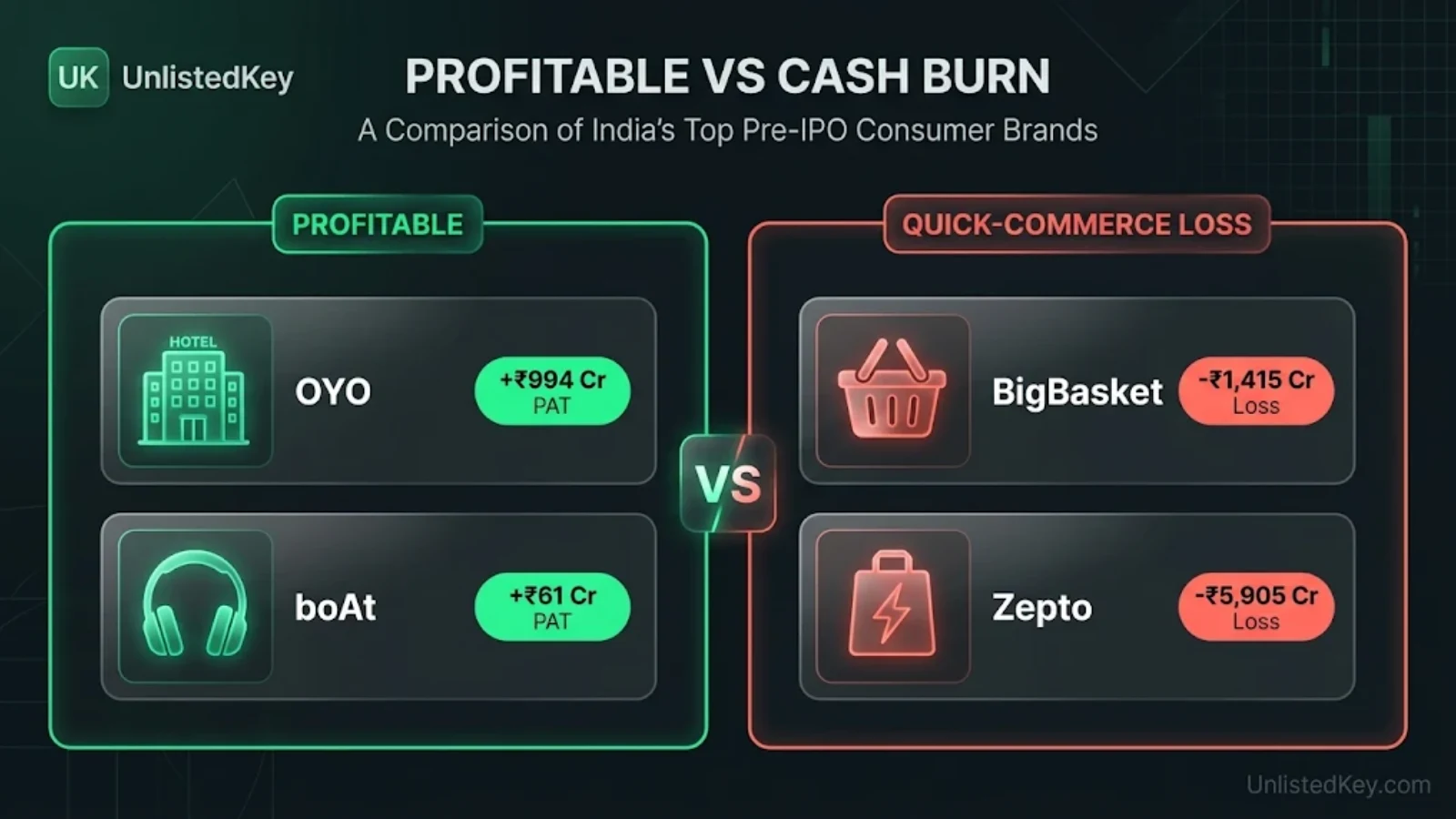
OYO / Oravel Stays (₹24.50 | 34.5x P/E | 1.7x P/B): OYO has turned profitable with ₹994 crore in PAT on ₹9,358 crore in net sales (OYO on Unlisted Key, Unlisted Key Screener), pricing it as a growth recovery story rather than a deep-value stock.
CSK (₹248 | 82.7x P/E) & Garuda Aerospace (₹438 | 88.1x P/E): Both are profitable and enjoy strong brand loyalty, but at 80x+ earnings, investors must size their allocations carefully (Unlisted Key Screener).
Zepto (₹33 | ₹22,624 Cr Sales | -₹5,905 Cr PAT): A high-velocity quick-commerce leader, but currently loss-making—meaning it belongs only in high-risk venture allocations, not conservative value portfolios (Unlisted Key Screener).
How to Research and Buy Unlisted Shares Safely on Unlisted Key
Unlike informal brokers who send undated prices on WhatsApp, Unlisted Key gives you institutional-grade transparency before you commit a single rupee:
Filter by Valuation on the Screener: Visit the Unlisted Key Screener or browse all 8 Unlisted Key Sectors to filter companies by P/E ratio, Price-to-Book, ROE, and profitability.
Verify Dated Dealer Snapshots: Open any company profile on Unlisted Key to inspect historical price snapshots and 3+ years of audited financial statements, shareholding patterns, and corporate events.
Raise a No-Obligation Enquiry: Select your company and quantity on Unlisted Key. Our desk confirms real-time stock availability and a firm transaction price before settlement happens directly into your NSDL or CDSL demat account.
Frequently Asked Questions (FAQs)
1. Which unlisted share has the lowest P/E ratio in India right now?
Based on current financial data on the Unlisted Key Screener, profitable companies trading at the lowest P/E multiples include Onix Renewable (4.3x P/E), Polymatech Electronics (5.1x P/E), Apollo Green Energy (8.4x P/E), and Anugraha Valve Castings (10.1x P/E) (Unlisted Key).
2. What is a good P/E ratio when buying unlisted or pre-IPO shares?
For established manufacturing, energy, IT, and NBFC businesses, a P/E ratio between 8x and 22x—or at least a 15%–25% discount to comparable listed peers—offers a healthier margin of safety against IPO price cuts and the mandatory 6-month post-IPO lock-in (Unlisted Key Screener).
3. Are the prices shown on Unlisted Key live stock exchange prices?
No. Unlisted shares do not trade on a continuous exchange order book (Unlisted Key). Every price on Unlisted Key is an indicative average of dealer quotes, published with the exact collection date and number of quotes behind it. Firm pricing and stock availability are confirmed when you raise a buy or sell enquiry.
4. How long does it take for unlisted shares to reach my demat account?
Once price and availability are confirmed on Unlisted Key and your KYC and payment are completed, off-market share transfers typically settle into your NSDL or CDSL demat account within 2 to 5 working days.
Companies in this article








Disclosure
- I (and anyone I write with) hold no position in the companies mentioned and don't plan to open one in the next 72 hours.
- I wrote this myself and it is my own opinion. I am not paid for it by anyone other than Unlisted Key, and I have no business relationship with any company mentioned.
- I am not registered with SEBI. This article is for education only and is not investment or trading advice.
This article is the author’s own view, reviewed by our editors for clarity and disclosure only. It is not a recommendation by Unlisted Key to buy or sell any security.