The Wake-Up Call Every Unlisted Share Investor Needed
For nearly a decade, there was one name that almost every Indian retail investor wanted in their demat account before it hit the stock exchange: the National Stock Exchange of India (NSE).
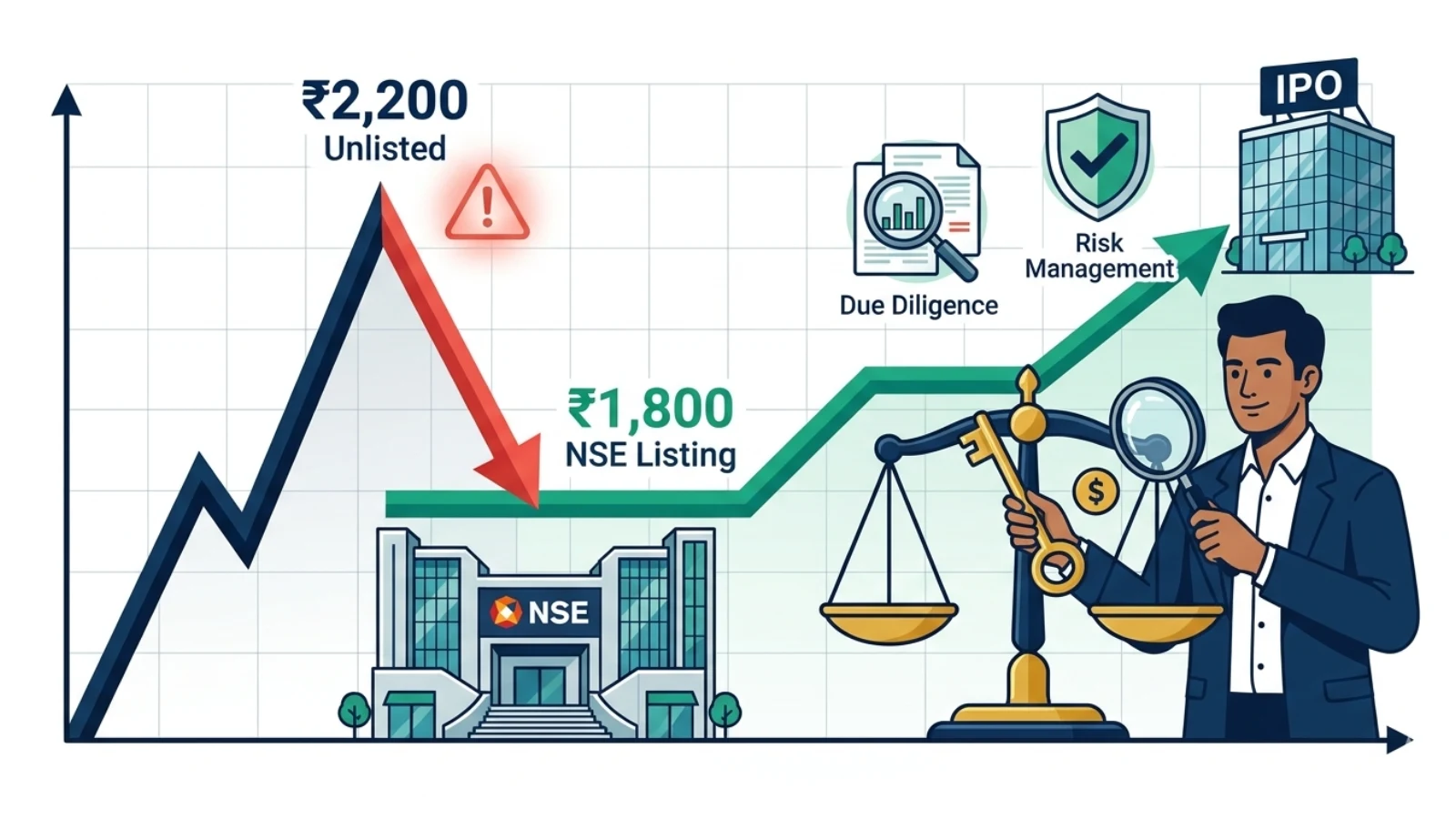
In WhatsApp groups, Telegram channels, and cold calls from informal brokers, the pitch was always the same: "Buy NSE unlisted shares at any price today, and you will make a massive profit on listing day." Driven by fear of missing out, thousands of retail and HNI investors bought NSE shares in the private market at ₹2,000, ₹2,100, and even ₹2,200+ per share (Economic Times).
Then came the reality check in September 2026.
When NSE finally announced its official IPO price band for the September 17–21, 2026 issue, the upper price was fixed at ₹1,785 per share (PL Capital). On September 24, 2026, NSE made its debut on the BSE at ₹1,800 per share—just 0.84% above the issue price (Groww). Within days, as broader market selling kicked in, the stock slipped below its IPO price to touch ₹1,761 and later ₹1,712 (Kotak Neo, TheSimpleHaiShow).
If you bought NSE in the unlisted market a few years ago at ₹700 or ₹1,000, you are sitting on healthy gains. But if you were a late-stage retail buyer who entered at ₹2,050 or ₹2,200 hoping for a quick listing pop, you were immediately staring at a 12% to 22% notional loss—with your shares locked in for six months after listing (Economic Times).
Why did India's strongest financial monopoly leave late pre-IPO buyers in the red? And more importantly, how do you make sure you never fall into the same valuation trap when researching your next unlisted company on Unlisted Key? Let's break down the real math in plain language.
NSE Unlisted Price vs. IPO Price: Looking at the Real Numbers
When a company becomes a household name, its price in the unlisted market often disconnects from its actual valuation. Before the IPO price band was announced, NSE unlisted shares were changing hands above ₹2,000 across private dealers (Economic Times, Unlisted Key).
Investor Entry Stage | Unlisted / Issue Price (₹) | Listing Day Price on BSE (₹1,800) | Post-Listing Low (₹1,712) | Reality for the Investor |
IPO Allottee (Sept 2026) | ₹1,785 | +0.84% | -4.09% | Entered at institutional book-built valuation with zero lock-in (PL Capital, TheSimpleHaiShow). |
Unlisted Buyer @ ₹1,900 | ₹1,900 | -5.26% | -9.89% | Modest notional drawdown; dependent on 6-month post-listing performance (Economic Times). |
Unlisted Buyer @ ₹2,065 | ₹2,065 | -12.83% | -17.09% | Bought during peak pre-IPO buzz; needs a 20%+ rally from ₹1,712 just to break even (Unlisted Key, TheSimpleHaiShow). |
Unlisted Buyer @ ₹2,200 | ₹2,200 | -18.18% | -22.18% | Entered at peak FOMO markup; facing steep notional loss during mandatory lock-in (Economic Times). |
This was not an isolated accident. Over the past two years, Indian retail investors have seen the exact same movie play out in several hyped pre-IPO names:
HDB Financial Services: Retail investors aggressively bought HDB Financial in the unlisted market at prices touching ₹1,500+ per share, only for the official IPO price band to be fixed roughly 40% lower at ₹700–₹740 (Zerodha).
Reliance Retail: Investors who chased unlisted shares at steep premiums faced up to a 60% haircut when the company proposed a share capital reduction (Zerodha).
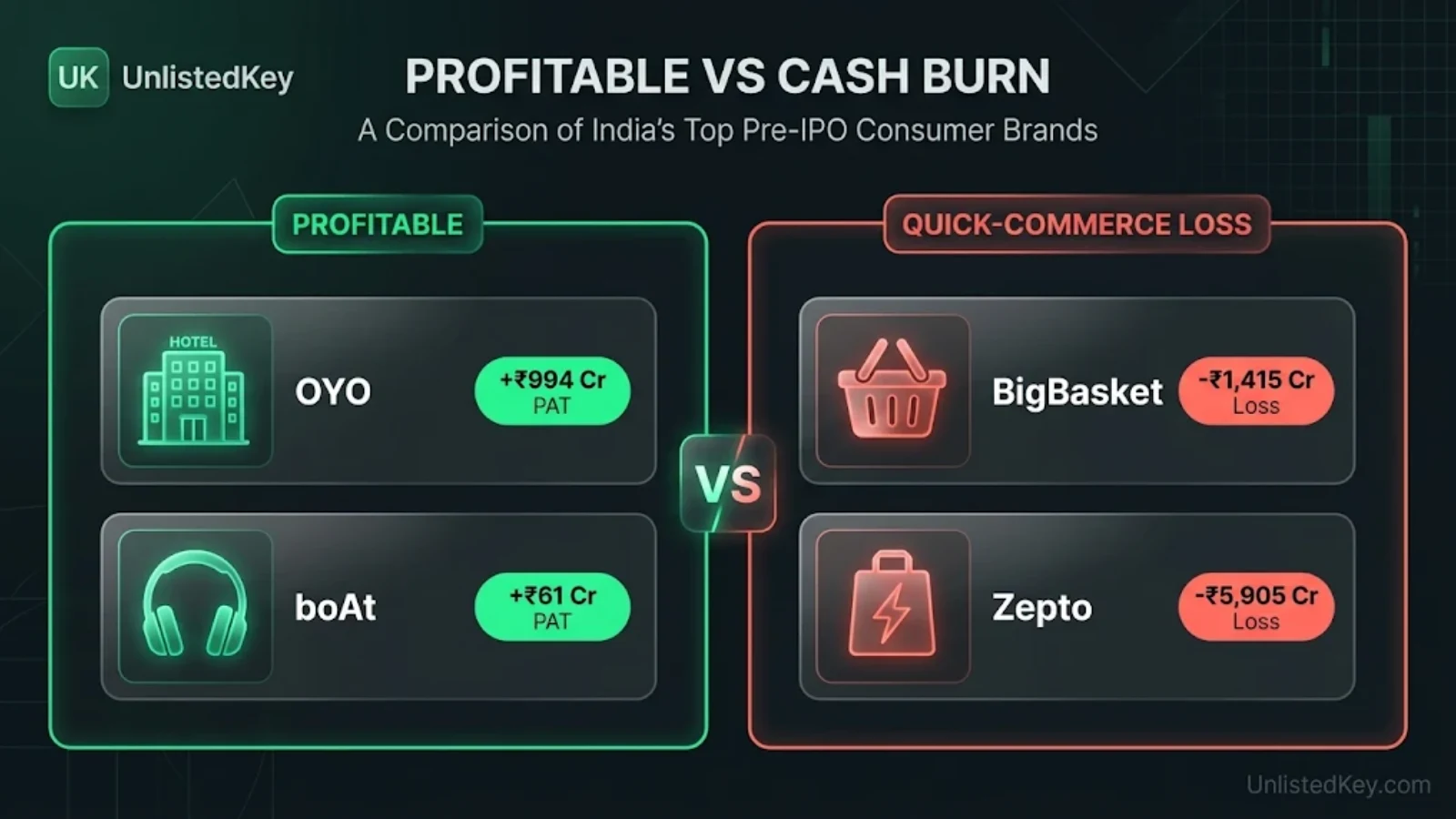
PharmEasy (API Holdings): Once traded at sky-high unlisted valuations during the pandemic tech boom, PharmEasy now sits at an indicative price of ₹5.60 on Unlisted Key, down 25.3% over the past year.
Why Does an IPO Price Come Lower Than the Unlisted Share Price?
Many first-time buyers assume that an "unlisted price" is a base price and the IPO price will naturally be 20% or 30% higher. In reality, there is no rule in the Indian stock market that says an IPO must be priced above private dealer quotes.
The unlisted market and the IPO market calculate value in two completely different ways:
1. Scarcity and Hype Drive Unlisted Prices
In the unlisted market, there is no live stock exchange order book (Unlisted Key). Shares move through negotiated off-market transfers between existing holders (like employees with ESOPs or early investors) and new buyers (Unlisted Key). When news breaks that a famous company is filing its Draft Red Herring Prospectus (DRHP), thousands of retail buyers rush to buy a tiny pool of available shares (Value Research). Because supply is tight and everyone wants in, intermediaries mark up the price—building a massive "IPO expectation premium" into the quote long before the IPO even opens (Zerodha).
2. Institutional Buyers (QIBs) Set the IPO Price Band
When a company actually launches an IPO—especially a massive ₹22,500+ crore Offer for Sale (OFS) like NSE—it cannot price the issue based on what retail buyers paid in small off-market lots (The Edge Malaysia, PL Capital). Merchant bankers have to sell half the issue to mutual funds, insurance companies, and foreign institutional investors.
Institutional fund managers do not care about WhatsApp buzz. They look at earnings growth, regulatory headwinds in derivatives trading, and how NSE's P/E multiple compares with listed peers like BSE Limited. To ensure the IPO gets subscribed 5.71 times and leaves room for institutional participation, NSE lowered its price band to ₹1,700–₹1,785 (The Edge Malaysia, PL Capital).
3. The 6-Month Lock-In Trap Doubles the Pain
When you apply in a regular IPO and get allotment, you can sell your shares at 10:00 AM on listing day if the market turns weak. When you buy an unlisted share before the IPO, SEBI regulations lock in your pre-IPO holdings for six months from the date of IPO allotment (Economic Times). That means if you overpaid by 20% right before the DRHP, you cannot exit on listing day—you have to sit through six months of market volatility before your shares become tradable.
How to Avoid the Pre-IPO Valuation Trap: 5 Rules for Smart Investors
Does the NSE episode mean you should avoid unlisted shares altogether? Not at all. Early investors who bought NSE when valuations were reasonable made extraordinary returns over the years. The lesson is simple: a great company bought at a bad valuation becomes a bad investment.
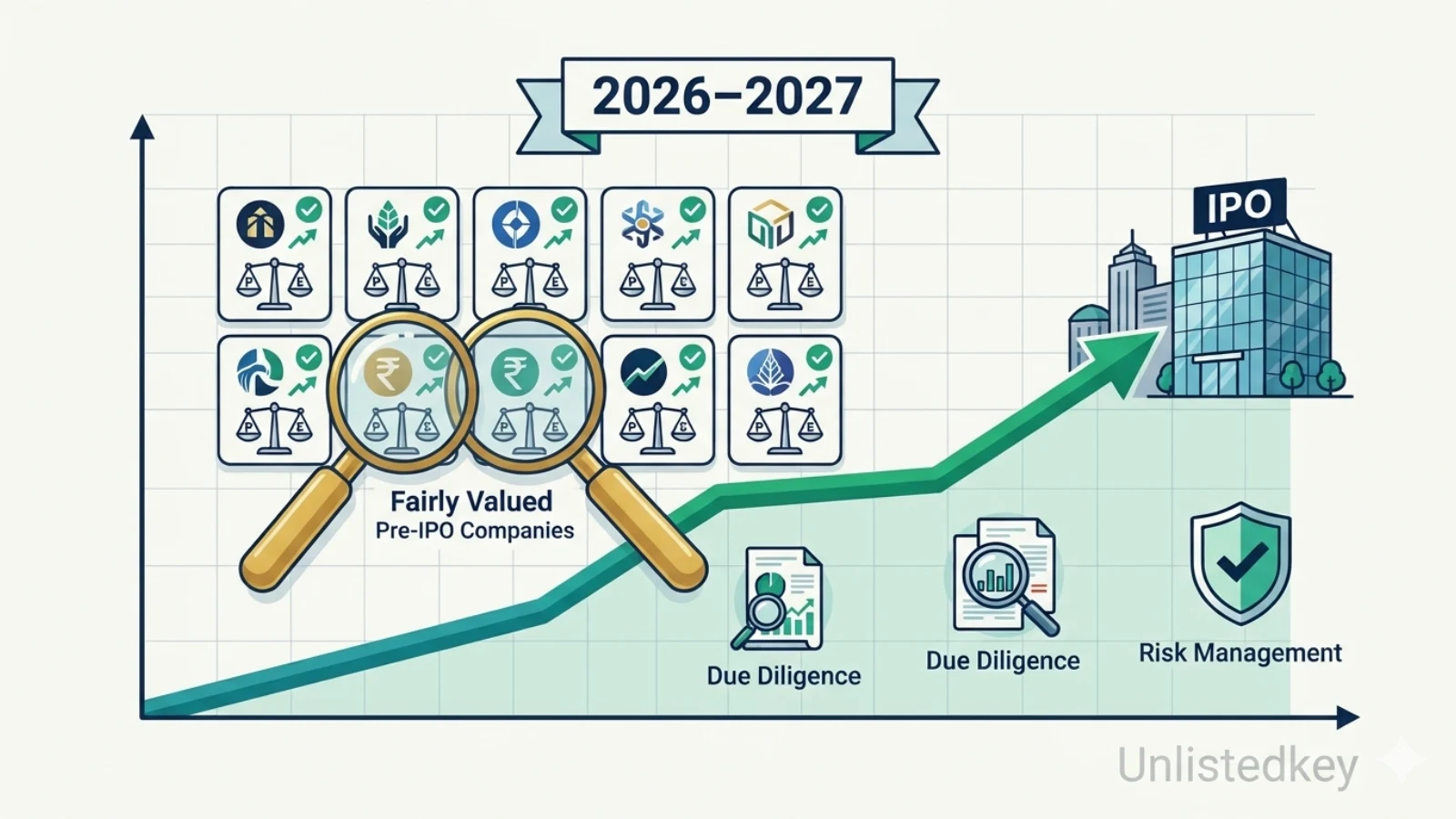
Before you raise a buy enquiry on Unlisted Key, run every stock through this 5-point checklist:
1. Check the P/E Ratio and Market Cap—Never Just the Share Price
Retail investors often look at a ₹50 share and think it is "cheap," or look at a famous brand and ignore the implied market cap. On Unlisted Key, every company profile displays the implied market capitalisation and Price-to-Earnings (P/E) multiple right next to the indicative price.
Compare the difference between chasing overheated multiples versus researching reasonably valued businesses on Unlisted Key:
Reasonable Industrial & Energy Valuations: Companies on Unlisted Key such as Apollo Green Energy (₹70 indicative price, 8.4x P/E), Anugraha Valve Castings (₹555 indicative price, 10.1x P/E), Amol Minechem (₹900 indicative price, 11.6x P/E), and A One Steels India (₹322 indicative price, 19.9x P/E) trade at single-digit or teenage P/E multiples where earnings back up the price.
High-Multiple Names Requiring Extra Scrutiny: By contrast, companies trading at 90x or 200x+ earnings—such as Hindon Mercantile (93.2x P/E) or Bharat Nidhi (231.3x P/E) on Unlisted Key—require deep asset-value or special-situation analysis rather than blind momentum buying.
2. Avoid Buying Right After a Sudden 30%–50% Pre-IPO Spike
Whenever a company announces board approval for an IPO or files its DRHP, unlisted prices typically jump 25% to 40% within weeks (Value Research). Always check the dated indicative price snapshots on Unlisted Key. If a share was quoting at ₹230 three months ago and is suddenly quoting at ₹350 solely on IPO rumors without a matching jump in profit, you are paying the "FOMO tax."
3. Don't Blindly Chase "Next NSE" Sympathy Plays
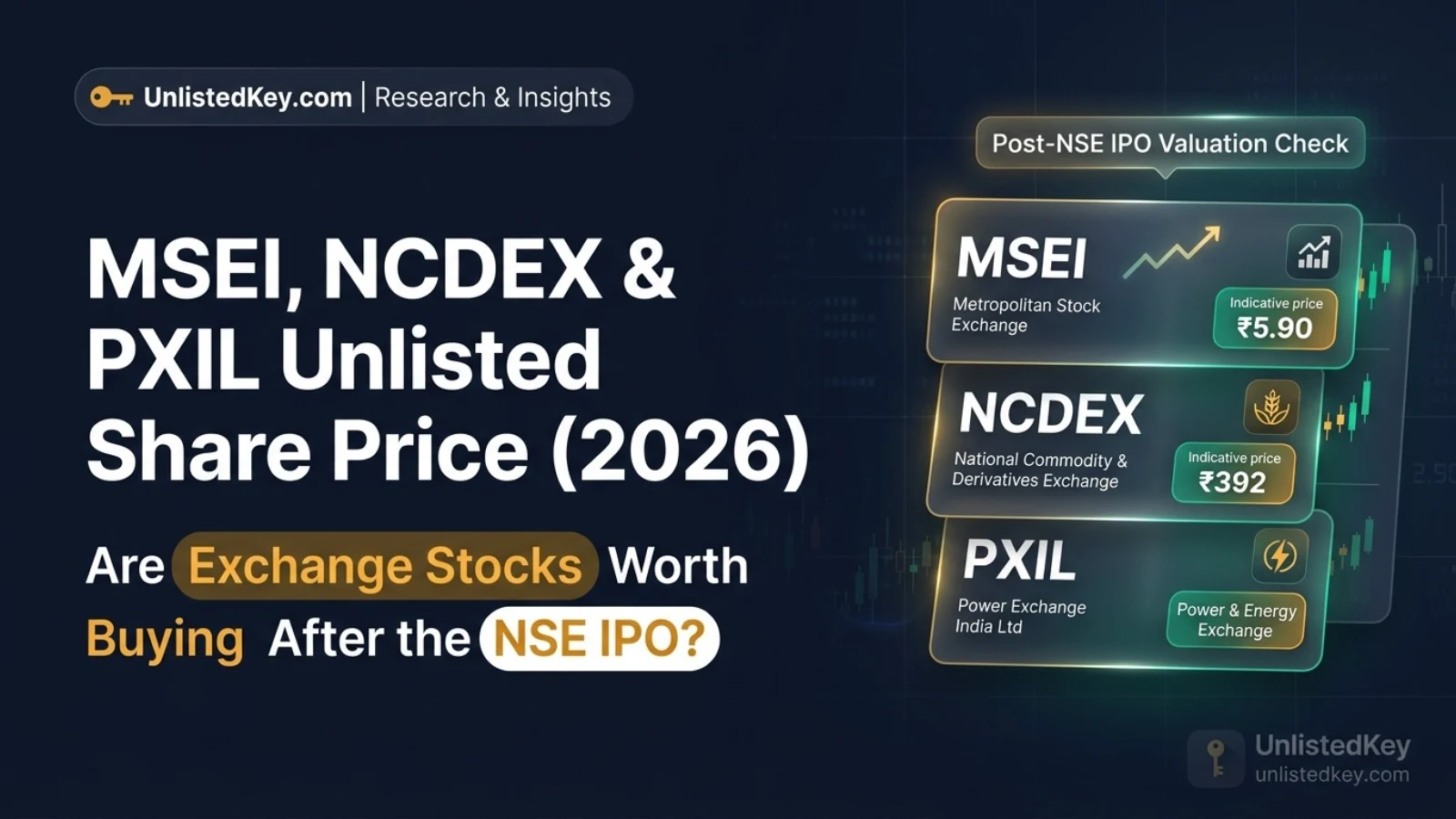
Now that NSE is listed on the BSE, many retail traders are rushing into smaller unlisted exchanges like MSEI (Metropolitan Stock Exchange of India) (quoting around ₹5.90 on Unlisted Key) and NCDEX (quoting around ₹392 on Unlisted Key). While both are legitimate market-infrastructure businesses covered on Unlisted Key, remember that NSE had a near-monopoly in equity derivatives. Never buy a smaller peer assuming it will automatically command NSE's valuation—check its standalone revenue, profitability, and market share first.
4. Compare Unlisted P/E With Listed Sector Peers
Before committing capital, ask one question: If this company were listed today, what P/E multiple would the stock market give it? For example, if you are evaluating an unlisted NBFC like Berar Finance (21.8x P/E on Unlisted Key) or Arohan Financial Services (29.7x P/E on Unlisted Key), compare their P/E and Price-to-Book ratios with listed mid-cap NBFCs. Because unlisted shares are illiquid and carry a 6-month post-IPO lock-in, you should demand a valuation discount to listed peers—not pay a 40% premium.
5. Rely on Dated, Multi-Dealer Quotes and Audited Financials
One of the biggest reasons retail investors lose money in the unlisted market is relying on undated price lists shared on social media. At Unlisted Key, every single company profile shows:
Dated indicative price snapshots collected from multiple active dealers so you can see the real historical price trajectory (Unlisted Key).
3+ years of audited financials, shareholding patterns, and corporate events with the exact source and date on every figure (Unlisted Key).
Enquiry-led execution where availability and firm pricing are confirmed before you ever transfer funds (Unlisted Key).
Frequently Asked Questions (FAQs)
1. Why did NSE IPO list at ₹1,800 when its unlisted share price was above ₹2,000?
Unlisted share prices are set by negotiated demand and limited supply among private buyers and sellers, which created an "IPO hype premium" above ₹2,000 (Economic Times). The official IPO price band of ₹1,700–₹1,785 was determined through institutional book-building to attract mutual funds and global institutions, resulting in a listing price of ₹1,800 on the BSE on September 24, 2026 (PL Capital).
2. Can investors who bought NSE unlisted shares sell them immediately after listing?
No. Under SEBI regulations, pre-IPO shareholders who are not promoters are subject to a mandatory 6-month lock-in period from the date of IPO allotment (Economic Times). Investors can only sell those shares on the exchange once the lock-in period expires and the ISIN is unfrozen in their demat account.
3. Does a lower IPO price mean unlisted shares are always a bad investment?
No. Investors who bought NSE or other strong unlisted companies 2 to 4 years before the IPO at lower valuations still earned substantial multi-bagger returns plus dividends (Economic Times). Losses primarily hit late-stage retail buyers who entered at peak valuations just weeks or months before the DRHP without checking the implied P/E ratio (Zerodha).
4. How can I check whether an unlisted share is fairly valued before buying?
You can use the free Unlisted Key Screener and comparison tools on Unlisted Key to inspect 3+ years of audited revenue, net profit, P/E ratios, market cap, and dated historical price snapshots across 128 unlisted and pre-IPO companies before raising a buy or sell enquiry.
Companies in this article

Disclosure
- I (and anyone I write with) hold no position in the companies mentioned and don't plan to open one in the next 72 hours.
- I wrote this myself and it is my own opinion. I am not paid for it by anyone other than Unlisted Key, and I have no business relationship with any company mentioned.
- I am not registered with SEBI. This article is for education only and is not investment or trading advice.
This article is the author’s own view, reviewed by our editors for clarity and disclosure only. It is not a recommendation by Unlisted Key to buy or sell any security.