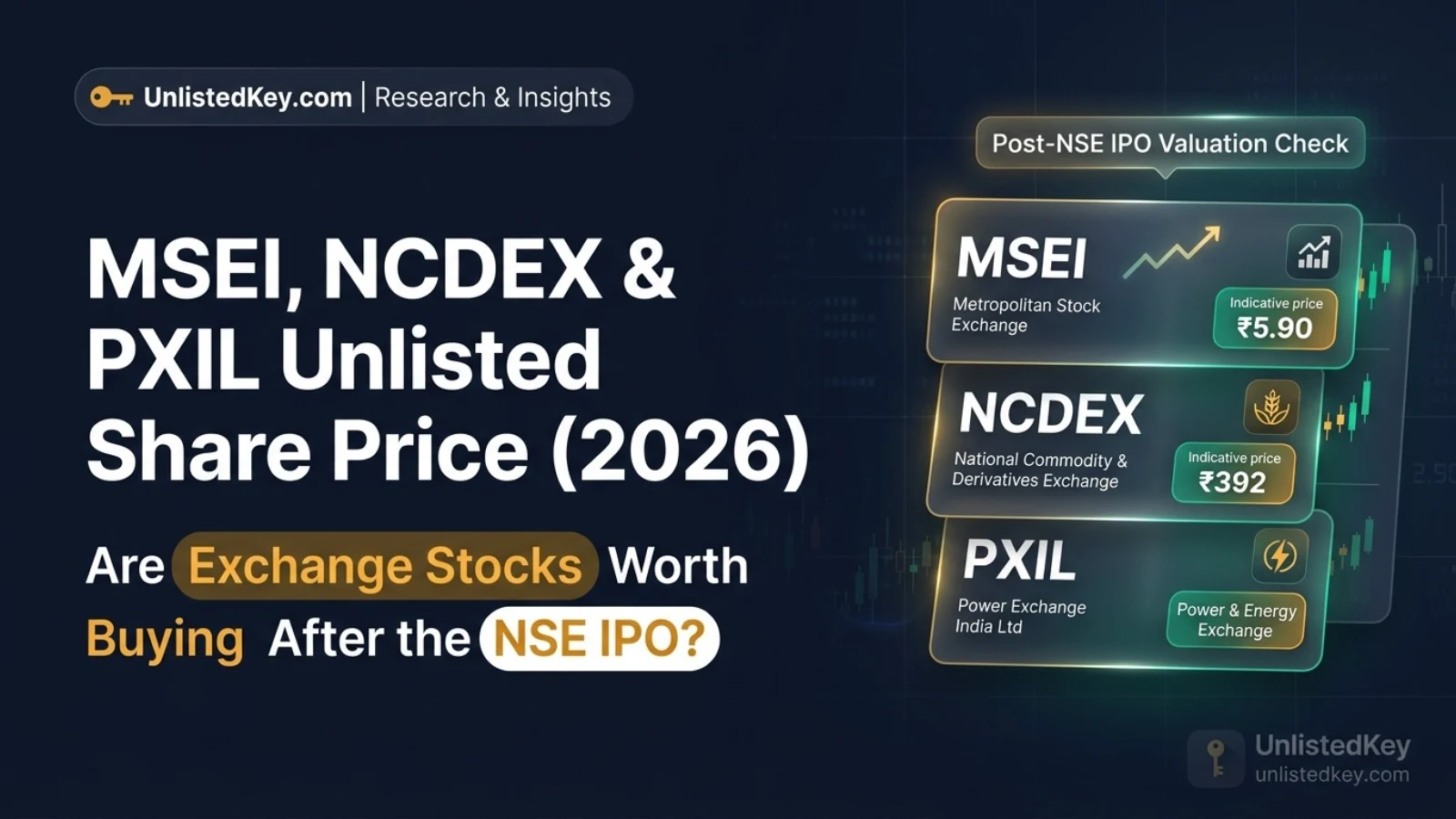
Where Did Unlisted Exchange Investors Go After the NSE Listing?
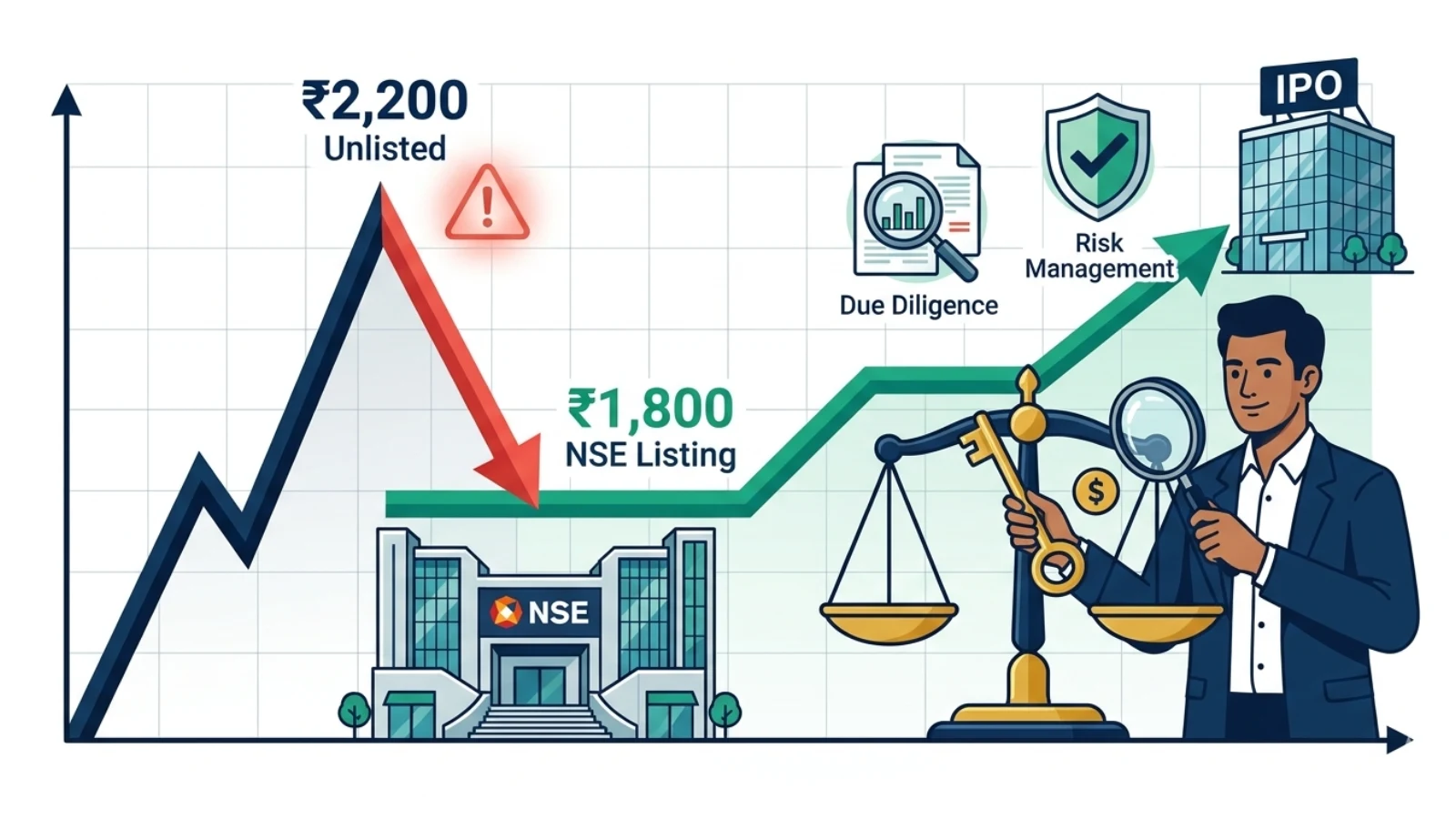
For years, the National Stock Exchange (NSE) was the undisputed king of India's unlisted share market. Now that NSE has completed its September 2026 IPO and is actively trading on the listed market, retail and HNI investors are asking the same question: "Which unlisted exchange stock should I look at next?"
Over the past few months, search interest and dealer enquiries have rotated heavily into three active exchange names on Unlisted Key:
MSEI (Metropolitan Stock Exchange of India)
NCDEX (National Commodity & Derivatives Exchange)
PXIL (Power Exchange India Limited)
On the surface, all three hold rare, heavily regulated exchange licenses in India—a business model with high barriers to entry. However, when you open the Unlisted Key Screener and compare their actual audited revenues, net profits, and implied market capitalisations, you quickly discover that one of these exchanges is highly profitable while the other two are loss-making turnaround bets.
Before you raise an enquiry to buy any unlisted exchange share simply because it carries the word "Exchange" in its name, let's look at the real numbers behind MSEI, NCDEX, and PXIL.
Head-to-Head Comparison: MSEI vs. NCDEX vs. PXIL (2026 Data)
Every figure below is taken directly from the reported company financials and dated indicative dealer quotes on Unlisted Key and the Unlisted Key Screener:
Metric | MSEI (Metropolitan Stock Exchange) | NCDEX (National Commodity Exchange) | PXIL (Power Exchange India) |
Core Segment | Equity, Equity Derivatives & Currency (Unlisted Key Screener) | Agricultural & Commodity Derivatives (Unlisted Key Screener) | Electricity & Renewable Energy Certificates (Unlisted Key Screener) |
Indicative Share Price (₹) | ₹5.80 – ₹5.90 (Unlisted Key) | ₹382 – ₹392 (Unlisted Key) | ₹498 (Unlisted Key Screener) |
Face Value (₹) | ₹10 (Unlisted Key Screener) | ₹10 (Unlisted Key Screener) | |
Implied Market Cap | ₹6,380 Cr (Unlisted Key Screener) | ₹3,426 Cr – ₹3,516 Cr (Unlisted Key) | ₹2,912 Cr (Unlisted Key Screener) |
Reported Net Sales | ₹3 Cr (Unlisted Key Screener) | ₹90 Cr (Unlisted Key Screener) | ₹86 Cr (Unlisted Key Screener) |
Profit After Tax (PAT) | -₹26 Cr (Loss) (Unlisted Key Screener) | -₹46 Cr (Loss) (Unlisted Key Screener) | +₹37 Cr (Profit) (Unlisted Key Screener) |
MCap / Net Sales Ratio | 1,887.6x (Unlisted Key Screener) | 37.9x (Unlisted Key Screener) | 33.7x (Unlisted Key Screener) |
P/E Ratio | N/A (Loss-making) (Unlisted Key Screener) | N/A (Loss-making) (Unlisted Key Screener) | 78.6x (Unlisted Key Screener) |
Price-to-Book (P/B) | 4.7x (Unlisted Key Screener) | 2.3x (Unlisted Key Screener) | 11.7x (Unlisted Key Screener) |
Look closely at the Implied Market Cap versus Net Sales row in the table above. Many retail investors assume that because MSEI quotes at ₹5.80 per share and PXIL quotes at ₹498 per share, MSEI is "cheaper." In reality, MSEI's implied market cap of ₹6,380 crore is more than double PXIL's ₹2,912 crore market cap—even though PXIL earns ₹37 crore in net profit while MSEI reports only ₹3 crore in net sales (Unlisted Key Screener).
1. MSEI Unlisted Shares: High-Stakes Turnaround Optionality
Metropolitan Stock Exchange of India (MSEI) is India's third SEBI-recognised national stock exchange, licensed across cash equities, equity derivatives, currency derivatives, and debt.
Why Retail Investors Are Talking About MSEI
MSEI has attempted to revive its trading volumes by raising fresh institutional capital from major discount broking ecosystem players and rolling out a Liquidity Enhancement Scheme (LES) to attract market makers. Because SEBI restricts weekly index options expiries per exchange, bulls argue that MSEI has a window to capture a small slice of India's massive derivatives volume.
What the Financials on Unlisted Key Actually Show
Here is the reality check every buyer needs to read before paying ₹5.80–₹5.90 per share:
Tiny Revenue Base: On the Unlisted Key Screener, MSEI reports just ₹3 crore in net sales and a net loss of ₹26 crore.
Massive Implied Valuation: Because MSEI has a huge base of issued ₹1 face-value shares, a ₹5.80 share price values the company at ₹6,380 crore—an eye-watering 1,887.6x Market-Cap-to-Sales and 4.7x Price-to-Book (Unlisted Key Screener).
The Verdict: MSEI is not priced on current earnings; it is priced like a venture option on whether India can support a third equity derivatives exchange alongside NSE and BSE. Only allocate risk capital that you can afford to hold through a multi-year operational rebuild.
2. NCDEX Unlisted Shares: Asset Value & Expansion Plans
National Commodity & Derivatives Exchange (NCDEX) is India's leading agricultural commodity exchange, backed by strong institutional shareholders. On Unlisted Key, NCDEX quotes around ₹382 to ₹392 per share, giving it an implied market capitalisation between ₹3,426 crore and ₹3,516 crore (Unlisted Key, Unlisted Key Screener).
Why Investors Track NCDEX
Unlike a pure single-product startup, NCDEX owns an ecosystem of market-infrastructure assets, including subsidiary stakes in clearing, repository services like National E-Repository Limited (NeRL) (which also trades in the unlisted market around ₹48 on Unlisted Key), and a promoter shareholding in PXIL. At 2.3x Price-to-Book, NCDEX trades at the lowest book-value multiple of the three exchanges (Unlisted Key Screener).
Key Risks to Watch
Regulatory suspensions on several core agricultural futures contracts over recent years weighed heavily on NCDEX's standalone exchange volumes. On the Unlisted Key Screener, NCDEX shows ₹90 crore in net sales and a net loss of ₹46 crore (37.9x MCap/Sales). For NCDEX to justify a major re-rating, it needs either a revival in permitted commodity contracts or a successful expansion into new financial segments.
3. PXIL Unlisted Shares: The Only Profitable Exchange in the Trio
While social media chatter focuses heavily on MSEI and NCDEX, Power Exchange India Limited (PXIL) is the only exchange among the three that is actively generating strong bottom-line profits today (Unlisted Key Screener).
Why PXIL Stands Out Fundamentally
Real Earnings & High Margins: On the Unlisted Key Screener, PXIL reports ₹86 crore in net sales and ₹37 crore in Profit After Tax (PAT)—delivering a net profit margin above 43%.
Smaller Market Cap Than MSEI & NCDEX: At an indicative price of ₹498 per share, PXIL's implied market cap is ₹2,912 crore (Unlisted Key Screener)—making it the smallest by total market cap despite being the only profitable business of the three.
The Market Coupling Catalyst: Promoted by NSE and NCDEX alongside major power utilities, PXIL operates day-ahead, term-ahead, and Renewable Energy Certificate (REC) markets. Investors closely watch India's proposed electricity market coupling reforms, which could help PXIL gain volume share against listed peer IEX.
Valuation Check on PXIL
Even with strong profitability, PXIL is not "cheap" in absolute terms—at ₹498 per share, it trades at 78.6x P/E and 11.7x Price-to-Book (Unlisted Key Screener). Investors buying PXIL are paying a growth multiple for scarce power-exchange licensing and regulatory upside.
Don't Ignore Other Market-Infrastructure Plays on Unlisted Key
If your goal is to invest in the plumbing of India's financial and power markets without paying 1,800x sales, you can also compare three related market-infrastructure companies on Unlisted Key:
Orbis Financial Corporation (₹344 | 20.4x P/E | 0.8x P/B): A SEBI-registered custodian and clearing member that earned ₹210 crore PAT on ₹488 crore net sales, trading below book value and at nearly a fourth of PXIL's P/E multiple (Unlisted Key Screener).
National E-Repository Limited (NeRL) (₹48 Indicative Price): A regulated electronic commodity repository promoted by NCDEX that digitizes warehouse receipts (NeRL on Unlisted Key).
HPX (Hindustan Power Exchange) (₹25 Indicative Price): India's newer third power exchange tracked under the Unlisted Key Sectors directory (Unlisted Key).
How to Compare and Enquire About Exchange Shares on Unlisted Key
Before you buy or sell any unlisted exchange stock, take three minutes to verify the data on Unlisted Key:
Compare Ratios Side by Side: Open the Unlisted Key Screener and filter by Exchanges & Market Infrastructure to view Market Cap, Net Sales, PAT, P/E, and P/B in one table.
Check Dated Dealer Snapshots: Because MSEI and NCDEX prices can move sharply on news headlines, inspect the dated historical price snapshots on Unlisted Key so you never overpay at the top of a short-term spike.
Raise a Buy or Sell Enquiry: Tell our desk the company and quantity on Unlisted Key. We confirm live stock availability and a firm price before settling directly into your NSDL or CDSL demat account.
Frequently Asked Questions (FAQs)
1. Why is MSEI's market cap ₹6,380 crore when its share price is only ₹5.80?
Share price alone never tells you how big or expensive a company is. Because MSEI has a very large number of ₹1 face-value shares outstanding, multiplying those shares by ₹5.80 results in an implied market capitalisation of ₹6,380 crore on the Unlisted Key Screener.
2. Which unlisted exchange in India is currently profitable: MSEI, NCDEX, or PXIL?
Among the three, PXIL (Power Exchange India Limited) is the only profitable exchange based on current reported figures on the Unlisted Key Screener, generating ₹37 crore in Profit After Tax (PAT) on ₹86 crore in net sales, whereas MSEI (-₹26 crore PAT) and NCDEX (-₹46 crore PAT) reported net losses.
3. Does the NSE IPO mean MSEI or NCDEX will also list soon at a high price?
No. Every exchange has its own market share, revenue model, and regulatory timeline. Neither MSEI nor NCDEX automatically benefits from NSE's listing, and investors should evaluate each company's standalone audited financials on Unlisted Key before raising an enquiry.
4. How can I buy or sell MSEI, NCDEX, or PXIL unlisted shares in India?
You can view dated dealer quotes and 3+ years of audited financials on Unlisted Key and raise a no-obligation buy or sell enquiry. Once our desk confirms availability and a firm price, shares settle off-market into your demat account in 2 to 5 working days.
Companies in this article



Disclosure
- I (and anyone I write with) hold no position in the companies mentioned and don't plan to open one in the next 72 hours.
- I wrote this myself and it is my own opinion. I am not paid for it by anyone other than Unlisted Key, and I have no business relationship with any company mentioned.
- I am not registered with SEBI. This article is for education only and is not investment or trading advice.
This article is the author’s own view, reviewed by our editors for clarity and disclosure only. It is not a recommendation by Unlisted Key to buy or sell any security.